Beehive Svg Review: A Designer's Take on Honey Graphics
As a designer who spends more time staring at stitch maps than most people spend looking at their phones, I approach every new digital embroidery file with a mix of curiosity and skepticism. When I first pulled up the Beehive Svg, Bee Svg, Honey Svg, Honey collection, my initial reaction wasn't just about the cuteness factor—though let's be honest, the theme is undeniably charming. My first thought was practical: "How will this actually translate from a vector line on a screen to a textured finished product?" Having worked with countless design assets in the Crafts category, I know that what looks perfect in a printable mockup can sometimes turn into a thread-breaking nightmare on the machine.
First Impressions: Mood and Visual Personality
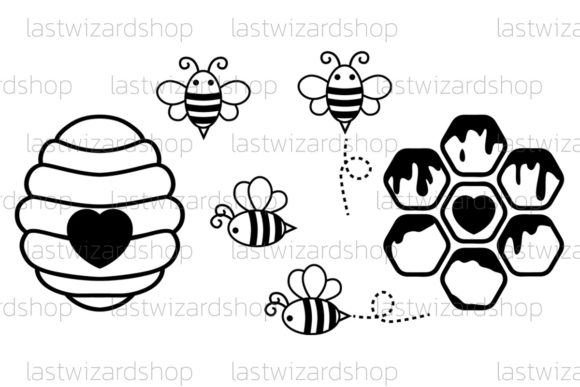
The visual personality of this Graphics set leans heavily into the sweet, rustic aesthetic that has taken over boutique branding in recent years. The shapes are generally clean, avoiding overly intricate details that often get lost in translation when converted to stitches. For an embroidery project, this is crucial. A design that relies on tiny, hairline vectors might look crisp on a high-resolution monitor, but on a tote bag design made of canvas or a fuzzy sweatshirt embroidery project, those details can vanish or cause excessive thread breaks.
The mood here is warm and inviting. It screams "spring," "nursery," and "homemade with love." Whether you are creating a personalized gift for a new mom or stocking shelves for a small shop product line, the Beehive Svg, Bee Svg, Honey Svg, Honey files offer a versatility that fits well within the current market trends. The layout feels balanced, suggesting that the original creator understood how negative space works—a vital element when you are dealing with stitch density and fabric texture.
Real-World Application: From Screen to Stitch
Let's talk about a real-life scenario. Imagine you are an Etsy seller preparing a batch of custom aprons for a local beekeeping cooperative or a family reunion. You decide to use the honeycomb element from the Beehive Svg, Bee Svg, Honey Svg, Honey set. In this context, the design needs to hold up under scrutiny. Unlike a vinyl decal which sits on top of the fabric, embroidery becomes part of the material.
If you are using these files for custom apparel, such as a toddler's onesie, the scale becomes your best friend and your worst enemy. The "Sweet Baby" aspect of the description suggests these graphics are sized or styled for smaller applications. However, before you hit start on your machine, you must consider the hoop size. If the design is too large for a standard 4x4 hoop, you might be forced to use a larger frame, which can be tricky on stretchy knits used for baby embroidery. Conversely, if the elements are too small, you risk the stitches merging together, turning a distinct bee into a blurry blob.
For commercial embroidery projects like branded caps or patches, the simplicity of the SVG lines is a benefit. Complex gradients in a digital file often require sophisticated auto-digitizing software to interpret correctly into satin stitch or fill stitch commands. With a clean SVG source, a professional digitizer (or a skilled hobbyist using good software) can easily map out efficient running stitch outlines and solid fills that minimize jump stitches and trim times. This efficiency directly impacts your profit margin as a craft business owner.
Navigating Fabric Challenges and Textures
One area where I always advise caution with nature-themed graphics is fabric selection. The Beehive Svg, Bee Svg, Honey Svg, Honey designs feature organic shapes that interact differently with various materials. On a smooth, tight-weave cotton tea towel, the definition will be sharp and the colors vibrant. However, if you attempt this on a textured linen or a thick terrycloth towel, the fabric's own grain can interfere with the visual clarity of the honeycomb pattern.
Stretchy fabrics present another hurdle. If you are applying this to a hoodie or a cap, the curvature of the surface can distort the geometry of the hexagon shapes inherent in a beehive design. A perfect circle on a flat screen can look like an oval on a curved hat brim. To combat this, the choice of stabilizer is non-negotiable. You cannot skimp here. A heavy-duty cut-away stabilizer is often necessary to prevent the design from puckering over time, especially if the finished product is intended for frequent washing.
Dark fabrics also require a strategic approach. If you are stitching a yellow bee onto a navy blue sweatshirt, the contrast is excellent. But if the design includes fine white details or light thread colors, you must ensure your digitizing settings include an underlay that is dense enough to prevent the dark fabric from peeking through. This is where checking the thread colors against your specific material is essential. Never assume the default color map in your software matches the physical thread spools you have in stock.
Enhancing Brand Value and Customer Trust
Why does the quality of your source file matter so much? Because in the world of handmade goods, the finish is everything. A customer might not know the difference between a satin stitch and a fill stitch, but they absolutely know when something looks sloppy. Using a high-quality base file like Beehive Svg, Bee Svg, Honey Svg, Honey allows you to produce a handmade product that exudes professionalism.
Consistency is key for brand consistency. If you sell a series of items featuring bees, hives, and honeycombs, having a cohesive set of graphics ensures that your Etsy listings look like they belong to the same shop. This visual harmony builds buyer engagement and trust. When a customer sees a well-executed embroidered patch or a neatly stitched pillow cover, they perceive higher value, which justifies a higher price point.
Practical Notes for the Serious Maker
Before you commit to a production run, here is my checklist for working with these types of files:
- Test on Scrap First: Always stitch a sample on the exact same fabric and stabilizer combination you plan to use for the final item. This reveals issues with tension and density immediately.
- Check Licensing: The description mentions these are cutting files for Cricut and Silhouette, but if you are using them for embroidery, ensure the license covers commercial use for design assets if you plan to sell the physical goods.
- Inspect Small Details: Zoom in on the vector paths. Are there stray nodes? Is the spacing between the bee wings sufficient for a needle to pass through without breaking threads?
- Mockup Verification: Create black and white mockups to check contrast. If the design loses its shape in grayscale, it might be too reliant on color rather than form.
- Digitizing Confirmation: Remember, an SVG is a vector graphic, not necessarily a ready-to-stitch embroidery file (like PES or DST). You will likely need to digitize it or convert it using specialized software. Do not assume the SVG imports perfectly into your embroidery machine without adjustment.
In conclusion, the Beehive Svg, Bee Svg, Honey Svg, Honey collection offers a solid foundation for creative entrepreneurs in the Crafts sector. Its strength lies in its adaptable, cheerful aesthetic that resonates with current consumer tastes. However, its success in your embroidery project depends entirely on your technical execution. By respecting the limitations of fabric, understanding the nuances of stitch types, and rigorously testing your setup, you can transform these digital lines into tangible treasures that customers will cherish. Whether it's a holiday embroidery gift or a staple item in your boutique, the potential is there, provided you bridge the gap between digital design and textile reality with care and precision.